Monday, 26 November 2012

COMMENTARY: Paracale mining tragedy: Poverty’s to blame


Gold miners’ shanties on the Palanas side of this sea-river. There are more clusters of miners’ shanties on the other side of the bridge (left of picture) where last week’s tragedy occurred. This section of Palanas directly faces the open sea. Notice a floating platform (left) for sluicing gold-reach earth hauled from Palanas. -- MWBuzzpic by AP HERNANDEZ


By ALFREDO P HERNANDEZ


EARLY LAST week, the Philippine media reported the deaths of three small-scale gold miners in Palanas, a depressed seaside gold district in Paracale, CamNorte.

These miners, said to be operating illegally for using dynamites, blasted a portion of an underground tunnel, which happened to be below the level of the seawater next to it.

The blast violently shook a portion of the tunnel just below the sea-river and collapsed, triggering water to come down and flood at least seven mining pits where the three miners were at work along with others.

Talks making rounds in Palanas had it that there were more miners who could have been trapped in the flooded tunnels.

As of this writing, the municipal government of Paracale was frantic in its search for survivors, while the Department of Environment and Natural Resources (DENR) began probing the incident, through the Mines and Geosciences Bureau (MBG), which has jurisdiction over mining activities in the Philippines.

Whether or not provincial Governor Edgardo Tallado should be blamed for this incident – again – is now out of the question.

The governor is the sole authority who could issue out small scale gold mining permits in the province, although right now, permit issuance is banned by MBG following disasters at gold mining districts in Mindanao.

And whether or not Tallado had issued such permits to this group of ill-fated Palanas gold miners remained hazy.

On the other hand, this is now a question of economics of the stomach, which keeps hundreds in Paracale to take such a risk.

Despite the grim prospect of death facing these poor miners, they can’t do anything but go on.

They have many mouths to feed everyday, and the gold money they make after a day’s hard work underground would surely keep their families going for another day’s grind the next day.

But the desire to earn a little more, thus taking further risk inside the tunnels and gold pits despite the hazard present and being deadly careless as well, is provoked by another factor – the proliferation of the so-called “entertainment spots” around the town of Paracale catering to many migrant miners from other parts of the province, including Mambulao.

These “beer joints” is said to be the other reason for such frenzy in looking for gold: to make an extra peso for their nightly escapade at the beer joints.

At night, many of such miners would kill time in these spots, talking to young waitresses and so-called “GROs” who are themselves dying to make a quick peso from these miners. The girls, most of them, came from far out baranggays of Paracale where the prospect of making a living is nil.

This is also one reason why the municipal government of Paracale has been vigilant to see to it that no minor girls work in these joints. The presence of girls as young as 15 was seen at these joints early last year, causing an uproar among well-meaning Paracalenos.

Hard-found gold and young rural girls working as waitresses/GROs are two ingredients that could easily make for a poor municipality like Paracale.

I have known Palanas quite well.

When I was just three, our young family settled just half a kilometer away from this tragedy site.

From the 1940s until 1951 when the mine – United Paracale or simply UP – ground to a halt after 56 miners died in the tunnel that was flooded by seawater after a tunnel collapse similar to last week’s tragedy -- Palanas served as the tailings pond of the gold mine.

Overtime, wide portion of Palanas dried up into solid grayish-brownish, gold-rich earth, providing the locals a good spot for weekend kite-flying.

And my father and I – then a three-year-old -- would be among those kite-flyers who would come from all over Paracale.

Occasionally, my neighborhood buddies and I would come to Palanas to play “gera-gerahan, baril-barilan” and hid among thick and tall “talahib” grass that hosted the nests of “pugo” and “maya’.

Palanas, which just overlooked the sea-river that surrounds the town proper of Paracale, making it practically as an island, was windy, making it the mecca for the town’s kite-flyers.

After the collapse of UP, life gradually became hard for many Paracalenos who solely depended on the gold mine for a living.

And business started to disappear as there was no more money to expect from the locals, leaving the community virtually a ghost town, allowing grass and tall talahib to overwhelm many vacant lots and front and back yards of many abandoned houses.

Many migrant workers from Bicol returned home; those who had farmlands such as coconut and other crops rediscovered their farm tools.

My father, who lost job as a driver-mechanic, returned to tending to his little coconut farm on weekdays and panned for gold on weekends.

We lived in a stilt house, one that sat above the seawater just like the rest in our neighborhood because we were right on the sea-river bank that separated us from Palanas, which was on the other side of the banks some 500 meters away.

Father would haul off gold-rich earth from the banks of Palanas in a small dug-out banca and deposit it into a platform under our house just a foot above the seawater level.

From here, he would do his panning for gold while it was high tide and the seawater was just a foot below the platform and easy to scoop; just before sundown, he would bring the gold dust in a small bottle to the town’s goldsmith for processing and then to the next-door gold buyer for some cash.

Later in 1954, we migrated to Mambulao after father found work at the Philippine Iron Mines (PIM) as a mechanic/driver.

We moved to Pasig for good in early 1970 when three of the oldest siblings in the family including me began attending the university. But my parents came back to Parang on occasions to visit our coconut farm in the nearby Paracale.

The daily gold hunt at Palanas has kept the economy of Paracale going even up to these days, especially now that the supposed mining companies – Uni Dragon Mining and Development Corp, the Bao Tong Mining Corporation and the Lioaning Fenghua Group Philippine Mining Company, Inc – had shut down after a disaster struck a tunnel operated by one of the mining firms early this year, leading to the drowning death of a number of workers.

This disaster alongside the one last week should be enough to make everybody in Paracale – especially the miners themselves – pause and ask: do we have to continue making a living in a deathly condition? Can we afford another disaster that could kill one of us this time?

I sympathize with these hapless miners since gold panning had once propped our young family above poverty during those days. 

And now, I myself  and these miners, are in a dilemma:

Go seek the gold and find death instead; cease and see a family who’ll soon starve to death.


Email the writer: ahernandez@thenational.com.pg  and alfredophernandez@y7mail.com


About seven houses to the right from where this picture was taken stood along the banks of this sea-river the family home of APH in the early 1950s. – MWBuzz by AP HERNANDEZ

The town hall of Paracale … helpless to stop illegal gold mining operations but succeeding in stopping girls of minor age from working at the town’s beer joints. 


This road leads to Palanas about 1km away, from the street junction in front of  the town’s ancient church and town hall.

The road leads to the seashore, from the road junction in front of the church and town hall. 
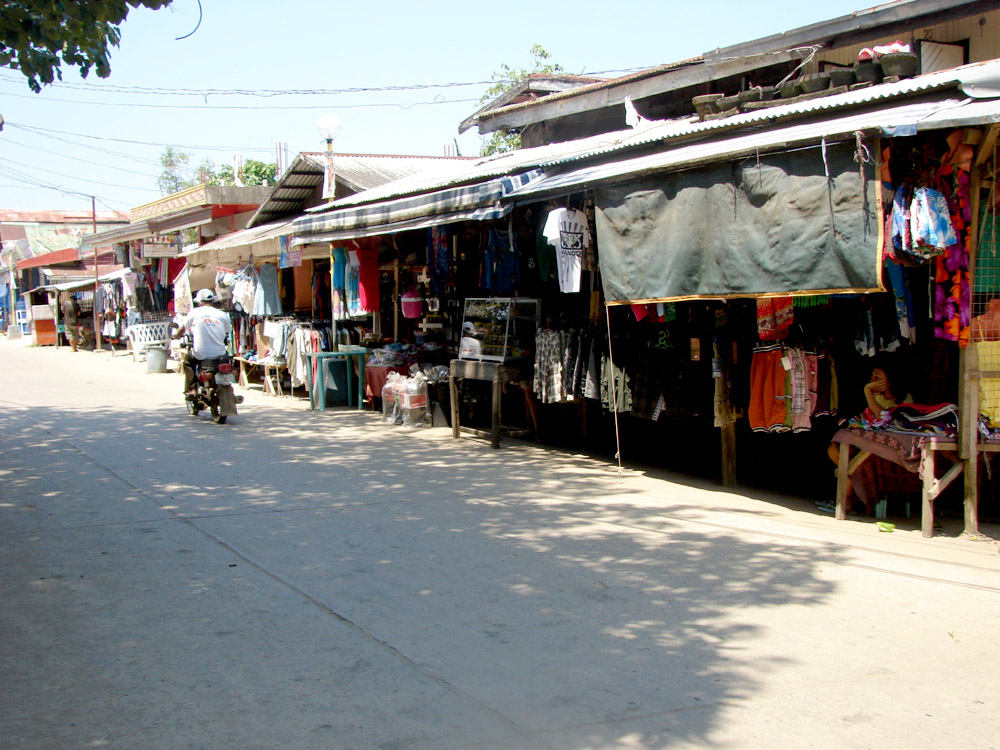

Shops prosper from the operations of legal and illegal gold mining operations in Paracale. – All MWBuzzpic by AP HERNANDEZ

NEWSFEATURE: Crisscrossing tunnels found in Paracale

A BOY plays with a banca in Barangay Palanas, a seaside mining community, in Paracale, CamNorte, seemingly oblivious of the mining disaster and retrieval operation in one of the thatched structures that house mining pits behind him. – Photo courtesy of JONAS CABILES SOLTES/INQUIRER SOUTHERN LUZON


By JONAS CABILES SOLTES and MAR A ANGELES


LEGAZPI CITY: Unabated diggings of crisscrossing tunnels by miners seeking gold ore deposits in Paracale, Labo and Jose Panganiban in CamNorte are invitations to major disasters during extreme weather conditions, said Gilbert Gonzales, regional executive director of the Department of Environment and Natural Resources (DENR).

Gonzales said during an interview that the Mines and Geosciences Bureau (MGB) was still counting the crisscrossing tunnels, including abandoned ones, made by small-scale mining operations. 

“The data would give us an in-depth study on the dangers posed by the mining operations in the three mining towns,” he said.

Lydia Burburan, DENR Ecosystem Research and Development Services Regional Technical Director, said miners had dug up crisscrossing tunnels ranging from 25 to 100m in vertical and horizontal mining shafts. 

These were discovered during an assessment of small-scale mining operations in the three mining towns in Camarines Norte.

She said the presence of this type of tunnels is a major issue that needs to be addressed by the DENR and provincial local executives. 

She said small-scale mining operations in the three towns produce 50 tons of gold yearly.

In Paracale, the body of small-scale miner Julian Cabaruvia, 22, floated up a mining pit last Thursday last week while another body was also sighted in the same pit that same day in the seaside village of Palanas, just 2km from the town proper here, the CamNorte police said.

The retrieval of Cabaruvia’s body from a pit around 7m away from where a blast was initially reported to have occurred on Wednesday bolstered suggestions that the blast could have pierced neighboring pits submerged in seawater, said Senen Inocalla, administrative aide of Paracale Mayor Romeo Moreno.

The Municipal Disaster Risk Reduction and Management Council placed the death toll at three due to the mining accident. The three were Cabaruvia, Luis Policarpio, 33, and Carlo Delos Santos, 27.

Authorities, however, believe more bodies could be trapped amid the rubble and debris that may have prevented bodies from floating up.

Help
Inocalla said rescuers have yet to explore and clear up the area where the accident happened but the municipal government had already asked help from the regional office of civil defense, which sent a team of nine, including technical divers, to oversee the operation on Thursday night.

“The retrieval operation has been hampered by lack of divers and by obstructions, including wood with nails and rock-filled sacks, which were making it almost impossible to go down the mining pits,” she said.

Authorities deemed at least seven mining pits were affected by the blast. The seven were among at least a hundred mining pits, with some exceeding depths of 20 meters, in the seaside community.

She said the local church has offered help to the municipal government.

Although out of town on an official trip, Moreno had given instructions to continue with the retrieval operation until all bodies were found, she added. 

Moreno had been criticized for leaving despite an ongoing retrieval operation.

The MGB has ordered the total dismantling of the structures in the mine site and urged the enforcement  of a cease-and-desist order earlier issued by local authorities.

Gonzales said there was an order to close down all small-scale mining operations in coastal areas following a “no-mining order” issued by the late Interior Secretary Jesse Robredo to local governments.

He said his office has no hand in the issuance of small-scale mining permits as it is the domain of the provincial government under the Local Government Code.

No one knew the whereabouts of mining financier Agosto Jordan, who allegedly owns the pit where the blast occurred.

Inocalla said because of the accident, the municipal government was bent on stopping all small-scale mining operations in the municipality and the eviction of all miners illegally operating in Palanas and its neighboring village of Malaguit.

“But we anticipate that the move would cripple the already failing economy of Paracale that is heavily dependent on mining,” she said.

Inocalla said  high-grade gold ore deposits in the seaside community has lured townsfolk to the area.

Gov Edgardo Tallado said the provincial government has been helpless in stopping illegal mining in Paracale because miners keep on returning despite cease-and-desist orders. - Inquirer


EDITORIAL: Gov Tallado: Leadership malfunction


A GOOD LEADER inspires; he can always persuade people with desired effect and influence or sway those who are unsure.

He also has all the charisma to groom somebody who could represent him and the cause he’s advocating, or shall we say, promoting -- in a community where he needed people’s utmost support and cooperation.

That’s why when Liberal Party provincial leader, CamNorte Governor Edgardo Tallado, named William A Lim as the LP’s candidate for the vice-mayoralty contest in Jose Panganiban, a million pairs of eyebrows jumped.

How come?

What happened to the LP leadership in Jose Panganiban that it is fielding WaLim ONLY as challenger to current vice-mayor Ariel Non, and not to Mayor Ricarte Padilla, who is seeking a second term?

It was Tallado’s desperate move to keep the LP ship afloat at Jose Panganiban’s political waters, which is ready to unleash a tsunami of winning votes for Padilla whether an election is held today or next year.

And the infamous provincial governor is betting on WaLim to shore him up.

WaLim can surely trash Non in the vice-mayoralty contest -- hands down --  with help from his built-in “balwarte” of voters across the municipality; the reported on-going animosity that developed over the past three years among Parang residents towards Aye, who are their “kabaranggay”, is also helping to shave votes from his own stock.

Not to mention a number of Mayor Dong Loyalists who are willing to drop Aye from their ballots as they want to see another vice-mayor next year.

But against Padilla, it’s a foregone conclusion that WaLim would be bludgeoned.

And this is a slap across the face of Tallado, who has no love lost for the incumbent mayor but has no man who could help him save his face.

And as far as MWBuzz is concerned, Tallado is a failed political leader representing the Liberal Party in CamNorte.

He’s failure to launch a candidate of Ricarte’s caliber to slug it out with the current mayor in the May 2013 local elections loudly speaks for itself -- that his leadership in the province is wanting and that no viable and potential politician-to-be is convinced to carry LP in Jose Panganiban under his leadership.

It’s no surprise that Tallado has been a big joke as far as the other LP bigwigs in five other Bicol provinces are concerned.

While LP in CamSur, Albay, Masbate, Sorsogon and Catanduanes are gearing it up against their equality strong opponents in all levels of the political stairs in their respective provinces, here is Tallado fielding his man in Jose Panganiban in the person of WaLim who is forced to go one-rank lower.

The national leadership of LP would surely be dismayed to find out that its Kingpin in Camarines Norte – Tallado – has failed to groom and hone somebody in Jose Panganiban to challenge Padilla’s regime of “good governance and astute leadership”.

Because it only means one thing for the LP – it won’t get winning votes in this second class farming-and-fishing-and-mining municipality for its senatorial, congressional and provincial line-ups.

What could be Tallado’s problem as the governor of CamNorte?

There could be many.

But the most glaring infractions that he could have done as leader were related to a host of corruption allegations that have something to do with gold.

Over the past three years of his term as the governor, Tallado has been alleged to have indiscriminately issued out permits for small-scale-mining operations in Labo, Paracale and Jose Panganiban even after a ban on new permits was imposed.

The Department of Local Government had suspended issuance permits for small scale mining operations following deadly accidents in the small-scale mining districts in Mindanao.

One reason why the late Interior and Local Government Secretary Jesse Robredo ordered a probe against the governor in July and sacked top police officers in the province for failure to stop illegal operations after a nationwide ban has been issued.

Tallado said while he discouraged illegal mining operations in Paracale, there was nothing he could do about it as gold provides a steady livelihood to more than 10,000 people in the province.

He was even quoted as saying “to stop them would be political suicide”.

The LP national leadership may praise Tallado for this stand for it assures the men running the party of rich votes for their candidates in CamNorte, courtesy of these gold miners – both legal and illegal operators.

But then, on the other hand, the party has no reason to be happy over his poor performance in selling goodwill for the party that would give them a winning edge in this municipality on May 2013 elections.

Jose Panganiban may be a small place with voters just numbering below 20,000, but the prospects of losing in this municipality owing to an inept political leadership is a painful option the Liberal Party has to accept for now.


- Alfredo P Hernandez


PREVIOUS EDITORIALS

=