Tuesday, 26 June 2012


Despite life’s glitches …  This woman can still smile for the camera as she busies herself baiting close to a hundred fish hooks for casting in the following night’s fishing expedition at the Mambulao Bay. Her fisherman-husband’s daily catch just barely meets her household needs as fish has become difficult to find, prompting him and the rest of other local fishermen to venture out of the municipal fishing zone where better catch could be had. They said that the bay has been overfished aside from being severely polluted by wastes from gold operations around the community. The mining wastes, they claim, are being dumped into the bay but the concerned government agencies such as the Environmental Management Bureau (EMB), Mines and Geosciences Bureau and the Department of Environment and Natural Resources (DENR) seem unmindful of the ecological problems in the community. – MWBuzzpic by ALFREDO P HERNANDEZ

COMMENTARY: JPNHS Alumni Association: What it can do


Fish vendors at Larap public market … hoping to boost their daily income from increased sales. Catch is just enough to make their ends meet, that’s why they can’t meet other needs of the household such as healthcare and education of their children. – MWBuzzpic by ALFREDO P HERNANDEZ


By ALFREDO P HERNANDEZ
Editor, MWBuzz

THE NEXT general alumni homecoming of graduates from the Jose Panganiban National High School JPHS will be on 2017.

During this five-year period, there would be lots of things to happen – both bad and good – as far as the Mambulao community is concerned.

The new leadership of the JPNHS Alumni Association that was elected at the recent homecoming is now looking towards the next five years – what it can do to help the Alma Mater, the community and its marginalized people.

A flurry of emails has been circulating among alumni who are hoped to deliver the goods to the beneficiaries of its various social programs once the planned actions have taken off.

But right now, the leadership, which is being spearheaded by Jun Espana of the Pag-Ibig head office in Manila, is quite bogged down with the structure of the group that would carry out such projects.

As you well know, the alumni are spread across the globe and those who have the capability to help push the organization to success are actually not based right in Mambulao, owing to their occupations.

Those who are nearby – say, those who live in Metro Manila – are the ones making up the core of the group that would be planning the course of action to take to reach this goal of bringing a change in the lives of our less-privileged kababayan and at the same time helping the local government on the ground carry out its mandated programs.

The association has many capable members in the US, Canada, Europe, Asia and Middle East. Of course, the association runs precisely because there are members who are right here and have direct hand in carrying out its programs.

The presence of well-off members overseas could help a lot, considering their exposures to their own field of callings, which, in one or the other, could help formulate better plans – the doable plans. And financially, they could also help.

These are the alumni who are in their early 40s as well as those in their 60s – professionals who are now desirous of seeing progress in their hometown -- progress or signs of it -- that  they missed when they were young high school students at JPNHS and young workers back then.

By now, they have been enlisted to help.

A woman residing at one of the squatter shanties along the beach of Parang washes kitchen utensils from the breakfast table … she could do more for the family with a little business venture financed by cheap capital. – MWBuzzpic by ALFREDO P HERNANDEZ

First and foremost, the association is looking at providing a cheap source of small capital to qualified Mambulaons who would like to engage in income-generating activities, such as buying-and-selling, food processing, service enterprise, and food/vegetable production, just to name a few.

While the community of Jose Panganiban is bustling with commercial enterprises with the influx of overseas dollars from Mambulao OFWs as well as from those who are permanently residing overseas, we know that one sector is being left out, and this is the group who are living the hand-to-mouth existence.

Many of them may have finished high school at JPNHS but are just luckless to be able to pursue further education which prevented them from finding jobs that would generate a sustainable living.

And there’s more.

The community is plagued with the so called “out-of-school children”, a term coined by the good town mayor Ricarte Padilla.

He told me in one of our chats at his office that our community is crawling with “out-of-school children” and not just “out-of-school youth”.

And this makes him quite exasperated.

The first groups, Padilla explained, are those who were never in the classrooms from ages 2 to 14, simply because their families did not have the means to send them to school.

And because of this, when they finally joined the school system, everything would just be a waste.

This is because during the formative year of a child from age two to seven, he/she already lost the golden opportunity as a child to transform himself mentally and to acquire traits and characteristics that would help them became good persons and good citizens.

 At 14, there’s no more chance for him/her to acquire proper intellect that a classroom lessons could provide.

In the end, they would become a burden to the community.

On the other hand, the so-called “out of school youth” are those who had been in school – during the entire elementary and primary years and those who were in high school – but dropped out along the way due to poverty.

This group still has a big chance of going back on the right track of their lives as they could still be salvaged, rescued and reformed inside the classrooms.

And maybe, when they finished the basic education, they can acquire work skills that would land them a good-paying job.

The municipal government of Jose Panganiban is now trying to address all this.

But of course, Padilla is not only concentrating on cementing the roads across the municipality.

It is also trying to encourage potential investors to come to Mambulao and put their money there so that such enterprises could generate jobs for the many jobless locals

Padilla told me our community has a wealth of labor, but it has become a waste because these men and women don’t have the work skills, thus rendering them unproductive.

He is also addressing this.

Without really being told, the JPNHS Alumni Association could realign its emerging priorities and be in tune with Padilla’s program while they are still being hatched to be in tune with the actual situation in the community: hand-to-mouth existence by the many and unproductive labor mass.

To me, the JPNHS can’t afford to operate on the other side of the common fence.


FOCUS: Endgame ng isang mahirap


The facade of the Philippine General Hospital along Taft Avenue, Manila.

By EMMA P VALENCIA, MD
HE IS a relative twice removed, husband to a cousin,  and I have been attending to him ever since he got bed-ridden from colon cancer.
I’m paying back, for all the good things he had done for my family - my parents, my aunts - when he was younger and strong.  
He is now just a bundle of skin and bones – almost like a cow’s carcass, if you have seen one. Far cry from his once-robust physique. 
But he is hanging on. He had undergone colostomy and  chemotherapy, but still  his cancer advanced to stage 4.
Recently, in two months he had two episodes of pneumonia  and bleeding from the stomach which needed hospitalization. 
On his latest hospitalization, he had to be transferred to a government facility because he could not afford the costly medical attention at a private hospital.
The charity ward was so full, humid and smelled of human suffering. Could we - his wife and me -- in all conscience, relegate him to this environment? 
He has only Philhealth, the government health insurance, and senior citizen’s  card, which altogether accounted for a discount of only about a third of hospitalization cost.
 As a retired security guard, his monthly pension was only about 5,000/month, but his former employer has been helping him defray some of his previous hospital expenses in gratitude for his long dedicated service to them.
But help from them this time may not be forthcoming.  He has some savings which he intends to leave to his wife (jobless) and kid (in school yet), but now it is  being depleted fast  because of his medication.
We decided to admit him instead to the payward which he shared with six other patients.
“Bahala na”, we told ourselves. We will see how far our finances will go.  Seeing our quandary, my cousin’s husband consoled us. 

: A family of a patient makes inquiry at the PhilHealth counter in Manila.
He said that that was the last time we will shell out money for him. He proudly told us that he had taken out a modest memorial plan (the cheapest, actually)  so  that   his funeral expenses would be taken cared of. That’s one less headache for you , he said. 

That's what he thought.  I could not tell him that I already knew about his memorial  plan, but he  cannot  use it  because the company from which he got the plan  went bankrupt and is now under receivership. 

The premium he religiously paid   from money saved by  skipping merienda, foregoing eating out or  watching a movie, or foregoing buying  new work shoes to replace his old, worn out pair- all came to naught.  Will his end game  be a  woeful checkmate? 
“Sa isang mahirap, mahirap mabuhay, mahirap mamatay.“
This guy is more fortunate than others in his income bracket.  If my cousin’s husband was not helped by his employers, he could not have undergone treatment, which allowed him to enjoy a  few added  years to his life.
One session of chemotherapy costs P30,000-P50,000 and on average a cancer patient has to undergo from six to eight  rounds.
The health insurance that the government provides is so paltry that most of the poor  and even the not so poor end up in charity wards where  service is – yes, as poor- as the patients.
And mind you, where before, medicines could be given free for the indigent, nowadays, every bit of service and medicine has to be paid, though pro-rated according to one’s means.
So, the sick poor postpone medical consultation and self-medicate, until  their symptoms have worsened. 
Just recently, a child was brought to me with a bloated, hard belly and thin arms. She had obstruction of the bowels and the doctor at the health center advised hospital admission for possible surgery.
The single  mother, jobless, refused going to the hospital because she had no money even for transportation. Even if I give her fare money, she would have nothing to pay for the laboratory exams needed, the medicines, and if needed, surgery. 
Anyway, to make the story short, I treated the child conservatively, and monitored her progress everyday just in case she got worse.
 With God’s help - and who else is there to help? the child is doing fine now. The obstruction turned out to be partial.    
But miracles do not come everyday, and the woes of the poor are so many, they need an avalanche of miracles! 
And so my head went into a tailspin when I read about the government’s plan to privatize government hospitals (reason is to help them be self-supporting or increase their revenues).  
Instead of expanding services to the poor, the government boxes them in a corner and knocks them out. 
The short-sightedness of government policy is truly blinding!
Money transferred or spent on the poor is an investment on human capital! You help them get back to their feet, you get more productive labor, even in the underground economy.
Being ill has tremendous ripple effect - sick bread winners cannot work - children stop schooling-more out of school children—less educated labor force - the poor sink in debt more. 


An indigent patient awaits treatment at the steps of the UP-PGH while protesters opposed to a new policy to charge the poor for basic procedures do their thing in this recent file photo. Photo courtesy of BERNARD TESTA, interaction.com


The cycle of poverty is perpetuated.  
“No budget” has been the mantra of government officials to justify the lack of services to the poor.
Hah, tell that to the generals with hefty retirement benefits, with matching pabaon!
Tell that to the managers of government financing institution who get thousands and hundred thousands of honorarium and allowance for just attending meetings.
 How about all that money used to maintain a bloated bureaucracy?  Since smuggling is so rampant, how about auctioning off the smuggled goods and channeling the funds to government hospitals?  
How about a portion of the toll fees to help improve health institutions? Big Business can also partner with government by “adopting” hospitals.
Community-based financing schemes can be expanded.  Philhealth, with its huge reserve, can expand its benefit package.   
There are many new or innovative ways to solve problems of health care financing, but the main  problem is that government technocrats do not realize  the enormity of the problem  and the human suffering it is creating .
The problem of the poor does not stop when they die.
The wherewithal for funeral expenses can be such a problem to those left behind. Thus, it is common to see a cards table in front of a house where the dead lies in state.
This is  one of the many ways - aside from getting a loan of 5/6 from the neighbourhood “bombay” -  the poor  resort to, to defray funeral expenses: conduct betting (card) games and get a portion of the gambling bets and winnings (from pusoy, tong-its, blackjack, poker, you name it) or what in the local parlance constitute a ‘tong”.
My “American” nephew once asked his Pilipino cousin: is there a party? after seeing a group of men and women singing, laughing, drinking, eating and gambling  in front of a house we passed by along the street where we lived.  
My Pilipino nephew answered with a poker face: no par-ty, only pa-tay.
My cousin’s husband - a poor but  good man,  does not have money for his funeral expenses. But there will be  no cards table in front of his house when he goes.
He will lie peacefully in a chapel, in an ambiance of prayer and remembrance of all the good things he has done.   
I will see to that. 


(Dr Emma P Valencia is a physician and a health policy analyst and researcher. She also writes essays and poems when she is not busy with her work on health. She lives with her 85-year-old aunt and seven dogs.)


Tuesday, 12 June 2012


Laundry woman … A woman (left) gestures towards the camera when she learns that she is being snapped. Taken at Parang beach in one of the squatter shanties along the shoreline, the picture shows Carol Island in the background.  The beach is again having problem with rubbish pollution, caused by wastes from other coastal baranggays that have been swept in during high tide. Mayor Ricarte Padilla has been asking leaders of coastal baraggays to deal with rubbish in their areas responsibly, but to no avail – MWBuzzpic by ALFREDO P HERNANDEZ


Girl on the beach … This young girl, one of the many kids who would bathe in the murky water of Parang beach every morning, is having a ball with her Styrofoam fload-surfboard this morning. The bay water, which has been spoiled by indiscriminate dumping of mud and silt from several mining operations around Mambulao’s gold district, has been a part of her life … but what the heck … that’s all what she has got for now, but hopefully, not for the rest of her life. – MWBuzzpic by ALFREDO P HERNANDEZ

Chapel donation … Mrs Elvira P Hernandez, 85 (left), of Pasig City, hands over to Fr Joselito chavez, an envelope with P10,000 as her donation to help the "Ermita" (chapel) at Parang, Jose Panganiban buy a new set of sound system. Fr Chavez, who offers the Holy Mass at the chapel every Sunday, until lately had been looking for donors since December to help fund a new sound system that has been malfunctioning ever since every time it is used during service. Mrs Hernandez answered the call early last month when she came to Parang for a brief vacation at her ancestral family home. The money was turned over to Fr Chavez after the Mass on Sunday, May 27, 2012. Incidentally, the Feast of San Antonio de Padua falls on Wednesday, June 13. -  MWBuzzpic by HELEN P HERNANDEZ-HELEN CORTES


In this Edition
Tuesday, June 12, 2012
Volume 1, No 15


Page 1 photos: Laundry woman/chapel donation …


2)  Editorial: Editorial No-helmet crackdown


News


Features

 Archives:
1) To view stories in the 13th edition, please click here
2)To view stories in the 13th edition, please click here
3) To view stories in the 12th edition, please click here
4) To view stories in the 11th edition, please click here
5) To view stories in the 10th edition, please click here
6) To view stories in the 9th edition, please click here
7) To view stories in the 8th edition, please click here
8) To view stories in the 7th edition, please click here
9) To view stories in the 6th edition, please click here
10) To view stories in the 5th edition, please click here
11) To view stories in the 4th edition, please click here
12) To view stories in the 3rd edition, please click here
13) To see stories in the 2nd edition, please click here
14) To see stories in the 1st edition, please click here  

Late-breakers by PERCY A OSTONAL


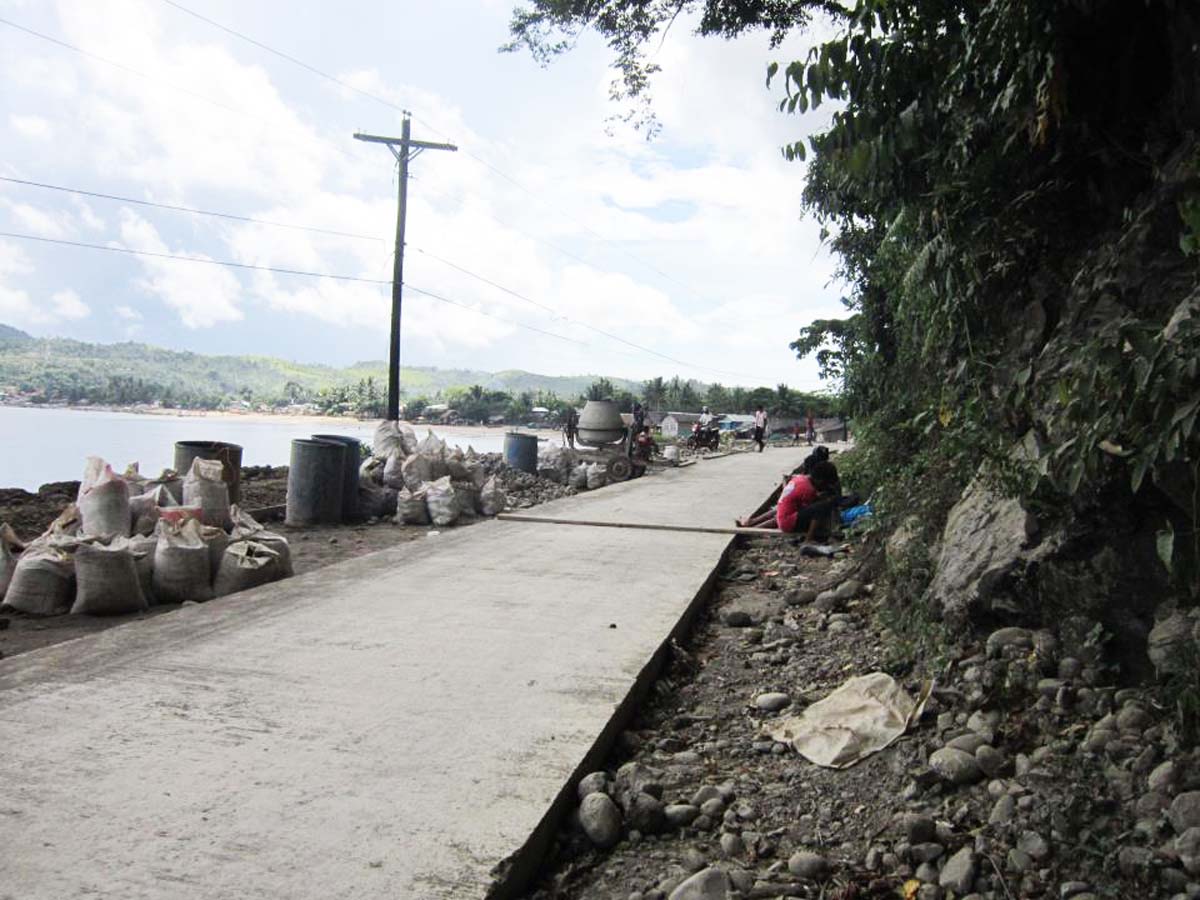
 A portion of the Parang-Larap road being cemented. - Photo courtesy of LGU-JP

Emerging "Bayanihan" spirits  way to go
IT IS heart-warming to know that the residents of baranggays Malapayungan and Calero have shown great deal of "bayanihan spirit" towards helping  the road cementing project of the current municipal administration. Report reaching Mambulaoans Worldwide Buzz indicates that folks in these communities have offered their labor "free of charge" in partnership with Mayor Dong Padilla's "progress in solidarity". More power to our "kababayans" from Malapayungan and Calero.

 
The “kalamansi” has become a new fixture in the local gold mining operations
 
Why "kalamansi" too expensive in J.P
WHO WOULD ever suspect that "kalamansi or kalamunding " these days would create an "incredible wonder” and “technological breakthrough” not only as food flavoring, popular drink, antiseptic, blood purifier as well as great natural deodorant alternative? (Just apply or rub it into your armpits after taking a bath and it will do its job wonderfully). A small, flavor-and-acid packed fruit that has a distinct citrus taste sometimes described as cross between lemon and mandarin orange, kalamansi has gone much farther from its traditionally known function. From average P20 to P30 per kilo two weeks ago, "kalamansi or kalamunding" now commands from P95 to P100 per kilo and is getting harder to find each day at JP’s vegetable market. Biggest suppliers from the province of Quezon and Batangas as well as that from Sipocot, Camarines Sur were all "scrambling " to get the larger share of the pie and have been to other neighboring places to meet customers’ demand for this "humble fruit”. Do you know why? Well, someone with fabulous and highly innovative mind introduced the use of its acid to find gold dust with their "pabirik"(panner). People currently using kalamansi juice believe that somehow , remarkable moments has finally arrived with lots of human and environmental advantages  to count with. “Asugi" or mercury has never been a real choice of any "magkakabod"  because it is costly and dangerous to humans’ health.
(Some information inserts were taken from: Rommel Bangit D315's Website, Market Manila by marketman website)

Dearth of carpenters willing to work in JP
IF EVER you are building a house or any building in Jose Panganiban, it is being advised to "import" carpenters somewhere else. Otherwise, you won’t  simply  find any carpenter willing to work for you. With the current legal daily minimum rate, carpenters or related skills would rather be gold panners earning P1,000 per day than work for eight hours under the sun for peanuts. Gold is everywhere in JP and can you blame them if they refuse to accept your job offer?

Drivers recognition day (May 5, 2012)
EXCEPT for the"kolorums" (non- registered) tricycle drivers, everyone joined the almost 1,000 plus colorful parade highlighting the First Drivers Recognition Day in Jose Panganiban last may 5, 2012. Mayor Dong Padilla and his administration  acknowledged the great contribution of this mode of transportation to the people of Jose Panganiban and its economic well-being. Each route has its own leadership organization and operates distinctly from others. 

Soaring numbers of  administration candidate  (applicants for councilors (2013 elections)
A FLASH report from reliable source said that some few dozens of candidate applicants for town councilors for 2013 local election are trying to "squeeze themselves in"  to the remaining three  spots under the Padilla administration ticket. The five same-political party-members re-electionists SB Aristeo E Arenal, Romeo M Arena, Sarah Marie P Aviado, Carlos R Taboada and Felino M Schneider IV are almost assured of inclusion. It is apparently not that easy picking up someone from the pool of qualified candidates as its titular head. Mayor Dong Padilla seems taking his time to decide and making 100% sure that his final slate and recommendation from  political advisers, allies, vice-mayor, council's partymates, immediate relatives and community elders are all but one. It was said that individuals of various professions, careers, job experiences, ages and gender are among the many applicants. Transparency, accountability, good governance, honesty, humility and respectful constituents, social services , infrastructure projects, resourcefulness, LGU accessibility , concern  to everyone and  lastly, ZERO TOLERANCE for graft and corruption summarize the mindset of the Padilla- Non tandem. "Serbisyo sa Tao Alay sa Diyos" (Service to our people is our offerings to God) is their battle cry. Latest highlight: A whole family clan with more than 30 from Baranggay Bagong Bayan recently pledged their political affiliation and support to mayor Dong Padilla and his administration. They were once with the other "political camp". 

If you can, I can do the same
UNKNOWN to non-residents and overseas "Mambulaoans", our brothers and sisters from the hinterland, which we had known (during our younger years in Mambulao) as "kabihog or aetas" are equally into the same livelihood grind with everyone these days. Remembering those years in the 50s and 60s – for them to survive and feed their families, they came down from their mountain lairs with wild boars, birds, “bayawaks”, “uways", “kangos”, “kamotes”, “saging”, “papaya”, "pakos”, “bayabas”  and "limurans" in exchange for Argo laundry bar soap, rice,  colorful clothing for women and children, sharp bolos and spears (for hunting purposes) candles, "calderos", Cortal tablets (painkiller) and of course "Sioktong” (a wine) or “Marka Demonyo" (gin). Without doing their native tribal dance (once they got tipsy) their long journey to the lowland would never be complete. Aside from attending regular basic education, our brothers and sisters are now engaged in small-scale mining to earn a living just like any regular "magkakabod”. They are much aware of the prevailing prices of gold in the marketplace at any given time.

JP prices for basic foodstuff
IF YOU been away home as OFW, or has settled in foreign land or live somewhere in the Philippines, will you not be anxiously enough to know how's your current earnings, retirement pensions, time deposits, stocks dividends, investment returns from your company's 401k or just pure savings can cope up with food prices in Mambulao if your ultimately choices settling back home ? A relative of mine recently gave me the following information and here are some of the very latest items and prices:

One sack of rice, 25 kilos first class "denurado" - P1,150
Fresh, big size of galunggong-- P100 TO p120 per kilo
Fresh small size of galunggong- P80 per kilo
Bangkulasi fish, fresh -- P250 per kilo
Turingan fish, fresh --P200 per kilo
Tangigi, fresh -- P250 per kilo
Gulay na “pako” P8 to 0 to P10 per bundle
Kangkong  “puting tangkay” -- P7 to P10 per bundle 
Just like everyone back in JP, it is so critical to discuss the price of electric power because barely,  according to the information source, price per kilowatt is not feasible to determine in the DARK -- brownout kadalasan kasi.

Monday, 11 June 2012

Editorial – No-helmet crackdown


A safety or crash helmet like the one in picture will give the bike rider a better chance to survive a fall.

IN THIS edition, we carry a report on the drive against bike riders who wear no safety helmets.

The crackdown was launched by the municipal government of Jose Panganiban at the beginning of last month.

A few days ago, a frequent visitor to Mambulao from Metro Manila has noticed that all riders – both the driver and the back rider – that she had seen were wearing the required crash helmets and she quipped: “Aba, halos lahat ng mga naka-motor eh may helmet … bakit kaya?”

Apparently, the initiative, which was resurrected from a five-year- old municipal ordinance banning riders with no-safety helmet, has been relative success.

We could say that the campaign up to this time has succeeded in removing from our roads potential addition to death statistics.

MWBuzz has reported (in this edition) four incidents of motorcycle mishaps that claimed at least four lives last April. They involved three men and a woman who died violently as their heads split after crashing on the concrete pavement.

The scenario of their deaths was common: A bike rider was driving ala- Evel Knievel -- that late motorcycle daredevil and stunt artist – along the town road with the usual disregard of pedestrians and passengers in other vehicles.

The presence of paved road in many spots in the poblacion has also encouraged bikers to drive wild. He/she would weave in and out of the lane as if trying to beat a deadline somewhere.

And he/she wore no safety or crash helmet.

Then, a MASSIVE CRASH.

After six weeks of operations that covered both the municipal and national roads on the outskirts of the poblacion, there seems to be a remarkable drop in motorcycle accidents.

Being careful this time is just a natural human reaction. The riders are aware that they are being watched by no less than 10 “anti-no-helmet biker” enforcers who are posted in strategic spots around town.

Their job is to check violators and impose a P100 fine for such a violation. And this has a dividend alongside – they are also able to ferret out unlicensed driver, badly maintained machine, expired driving licenses and more.

Since the enforcers get half of the fines collected, their eagerness to catch more violators is overwhelming.

This campaign is very timely because very soon, the entire municipality would see long stretches of cemented roads, which could be more fun for bikers to drive on.

Take for instance the Parang-Larap road – this is a more-or-less a six to seven kilometers of uninterrupted cemented road.

Just imagine the fun it would give a biker, who would love driving this long ribbon of cement at top speed, and non-stop.

So it really make sense to protect our bikers by requiring them to wear safety helmets after giving them a smooth road to speed on, but hopefully, not to die on.

-  Alfredo P Hernandez